Solution · Data quality & validation
One readiness score instead of twenty trackers.
Validation rules per object, a scorecard per site and programme, top offending rules with an owner next to each one, and a correction queue business users actually work. The data gets fixed in the source system; the steering committee gets one number and its trend. Built on SAP data; runs on any source — ERP tables, databases, flat files.
- since 2017
- DQ before every rollout wave at a global brewer
- 1 tender
- selected ahead of two global DQ vendors
- 5
- DQ dimensions per object
01
What usually goes wrong.
02 · How it runs in vise DMW
The same discipline at every step.
- Steps 1–2 · Extract and scope
Every site, every object, one programme.
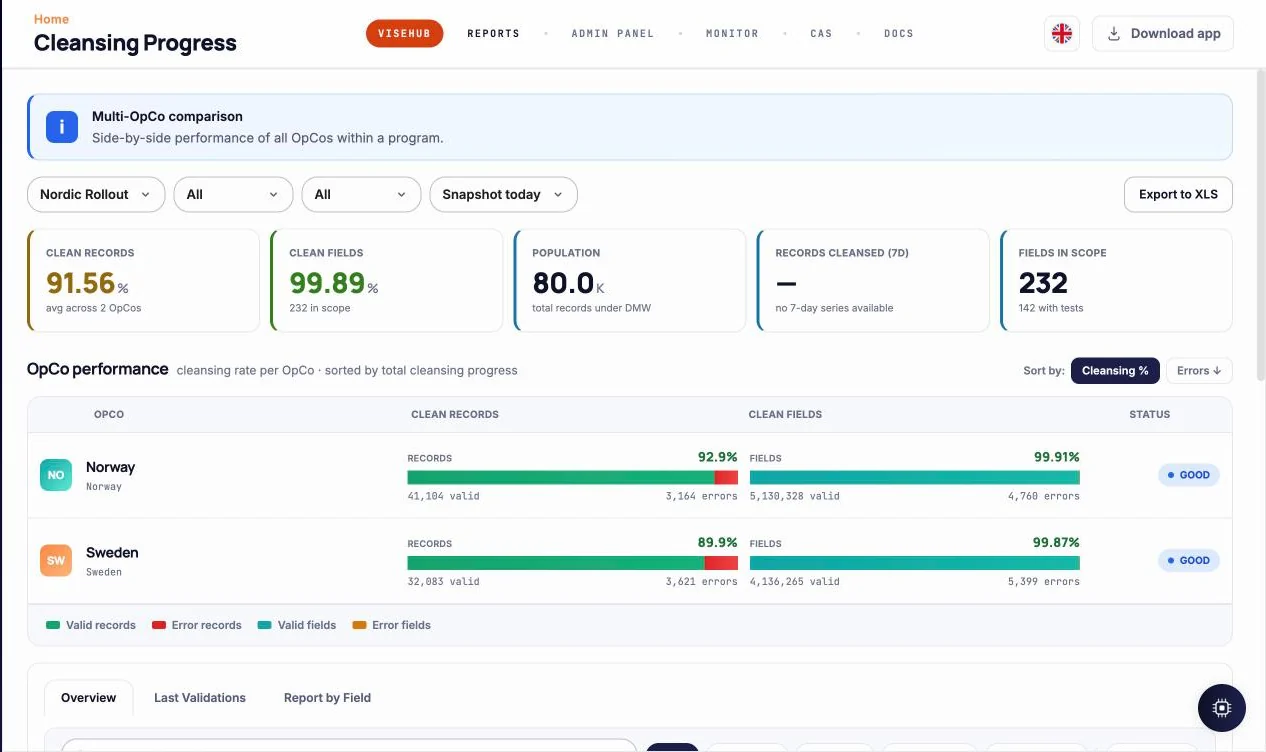
Extracts from SAP (or any ERP) per site, scoped to the objects in the wave: vendor, customer, material, open items, cost centres. Milestones and owners live on the project, so “who signs off Norway in 28 days” is a field, not an email.

Program → project → site - Step 3 · Validate
Rules as code, owned by a named person.
Format, list-of-values, conditional, custom and aggregate rules per field, each with severity, scope, documentation and an owner. AI drafts a rule from a sentence; a person switches it on. The same rule library runs for every site in the programme.
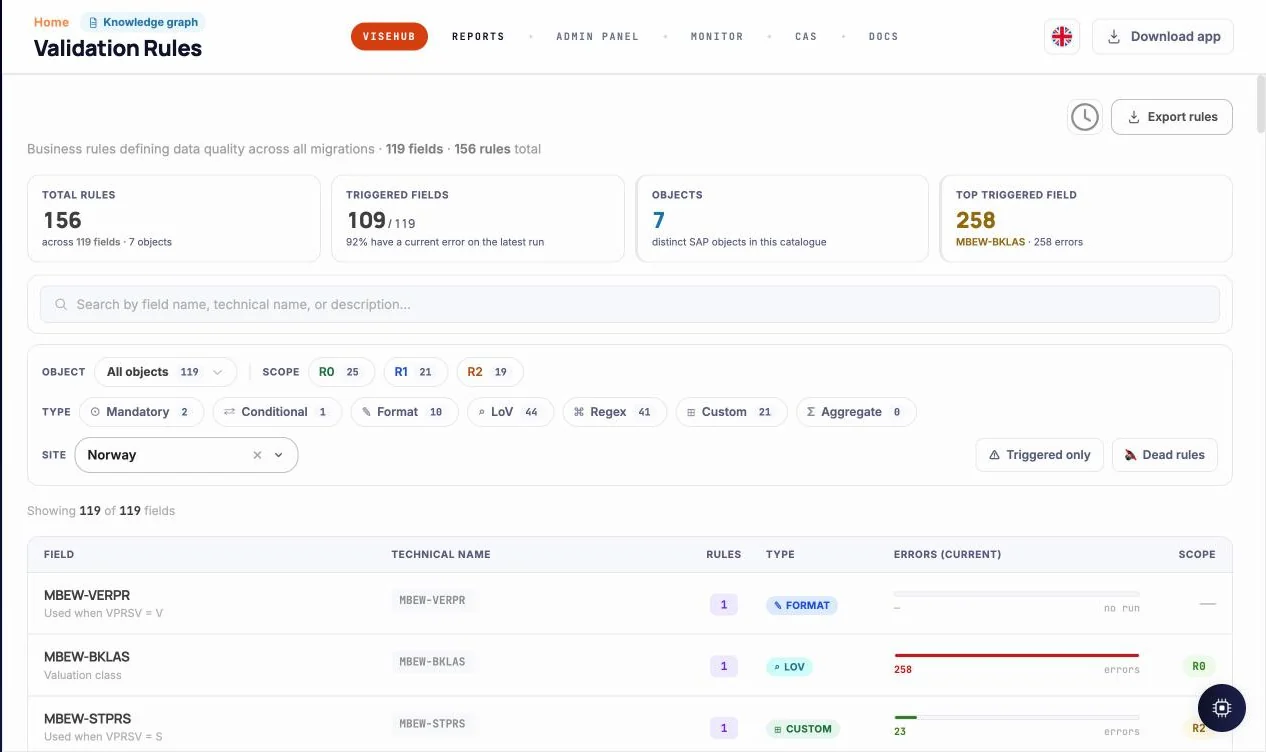
156 rules across 119 fields and 7 objects (demo) - Step 4 · Profile
One score, five dimensions, per object.
Completeness, validity, conformity, consistency and uniqueness, rolled up into a scorecard per site and programme with the trend since the baseline. This is the number the steering committee gets every week.
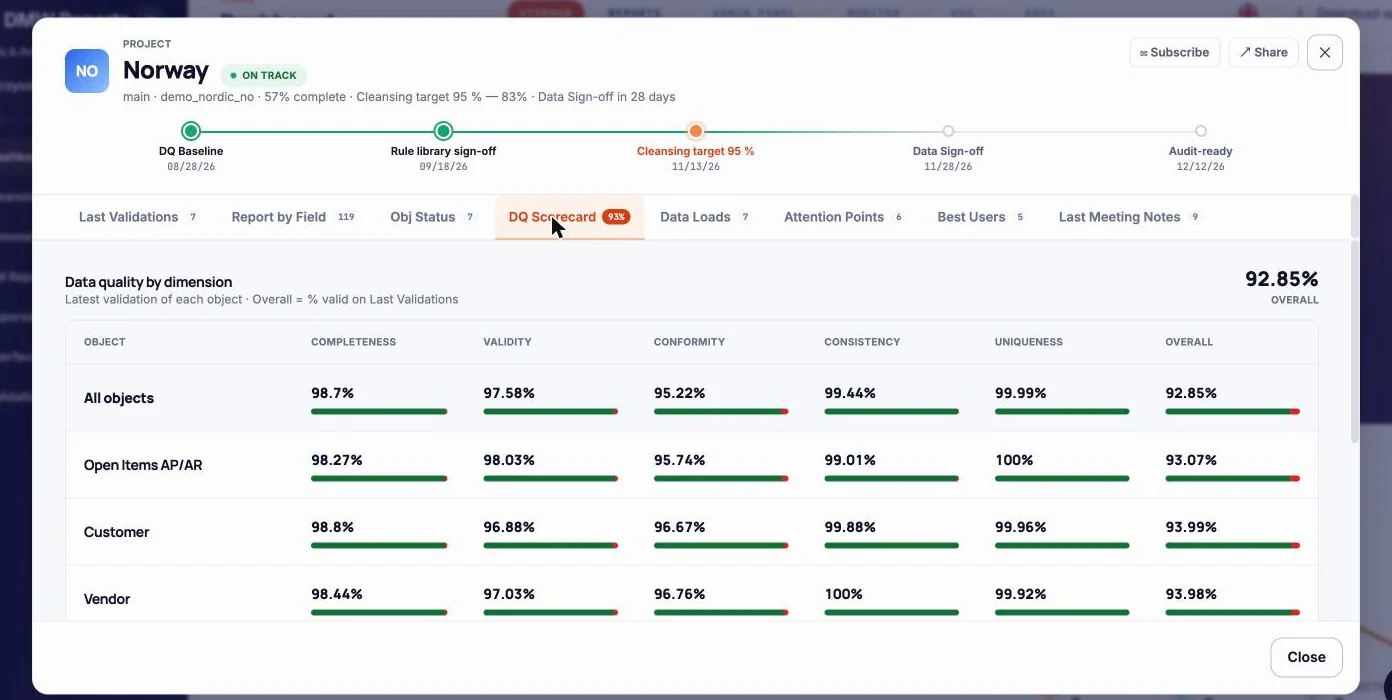
DQ scorecard — Norway, by dimension - Correction loop
Fix it in the source. Validate again. Watch the number move.
Error details go to the people who own the data, by object and by rule, with the reason in plain words. In a data-quality project corrections are always made in the source system — never in DMW — then the object is re-validated and the scorecard updates. Top offending rules show where the effort pays off first.
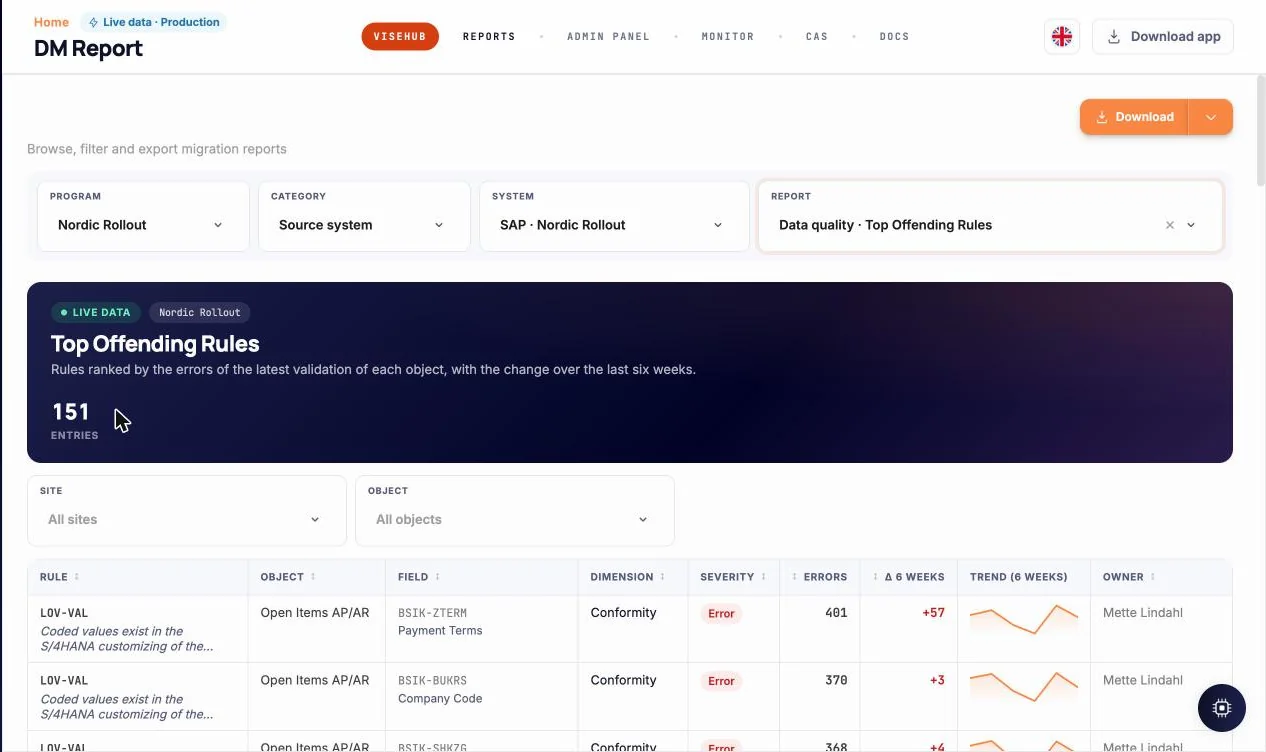
Top offending rules — errors, six-week delta, owner - Step 8 · Report
The Friday page, written by the system.
Weekly summary with movers and regressions, cleansing progress per operating company, attention points and meeting notes per project, Superset dashboards on the same validated data. No export, no slide deck.
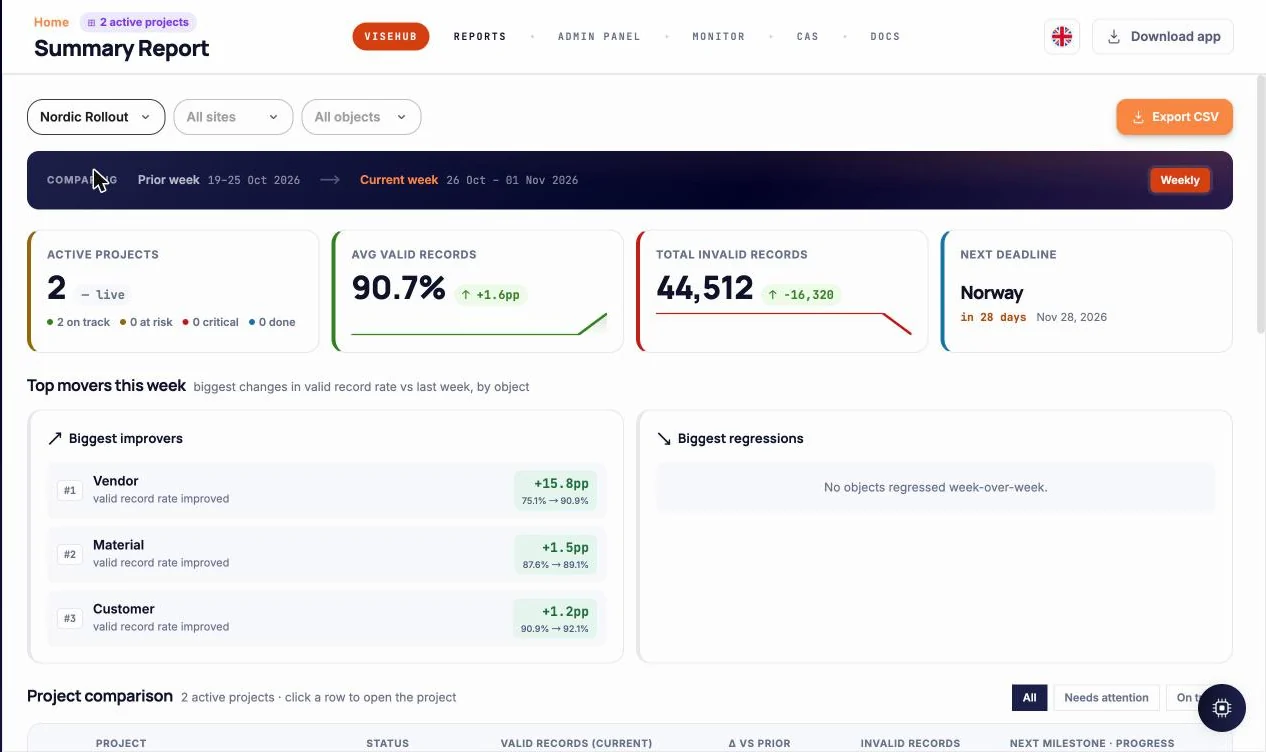
Weekly summary — who improved, what regressed
03 · 30-day proof of concept
What you have after 30 days.
- One object from your system extracted, profiled and validated against a first rule set
- A data assessment report: scorecard, top offending rules, what blocks the load
- A working DMW project your team can keep running — not a slide deck
- A proposal for the rule library and the correction process for the full programme
In production
DQ before every wave since 2017 Global brewing group vise DMW validates and profiles master data ahead of each SAP rollout across the group’s operating companies. Loads go through the existing BODS pipeline; DMW is the readiness gate. Read more Public tender Energy infrastructure operator Selected as the data quality platform ahead of two global data-quality vendors. Rules, scorecards and correction queues, with no migration attached. Read more- 01Do we have to migrate with DMW to use it for data quality?
- No. Our longest-standing customer runs DMW as the readiness gate in front of BODS. vise DMW can validate, profile and report while any load tool you already have does the loading.
- 02Where do corrections happen?
- In a data-quality project, always in the source system. DMW shows what to fix and why, the owner fixes it in SAP, DMW re-validates. There is no second copy of the truth.
- 03How is this different from Ataccama or Informatica?
- vise DMW is built around SAP objects and migration waves: rules per object, scorecards per site and programme, a correction loop for business users, and the same platform carries on into migration and everyday changes. Priced by sites and users, not an enterprise platform licence.
- 04What does the AI do here?
- It drafts validation rules from a sentence and tests them in a sandbox. A named person activates every rule. Nothing the AI writes touches your data unapproved.
Get one readiness score for one object in 30 days.
Pick the object that worries you most. We profile it, validate it and show you the scorecard — on your data, in a project you keep.